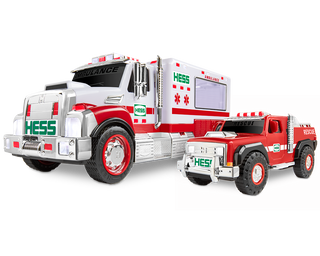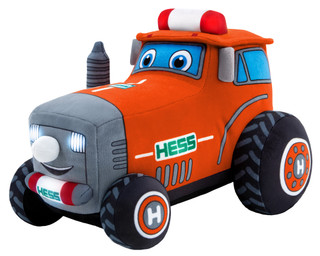
Figuring out what a Hess truck is worth really boils down to four things: the year it was made, its overall condition, whether it has all its original parts and packaging, and how rare it is. It's the difference between finding a treasure and just finding an old toy. A vintage truck in mint condition with its box might be worth thousands, while a common, unboxed one could be worth just a few dollars.
Table of Contents
What Really Makes a Hess Truck Valuable
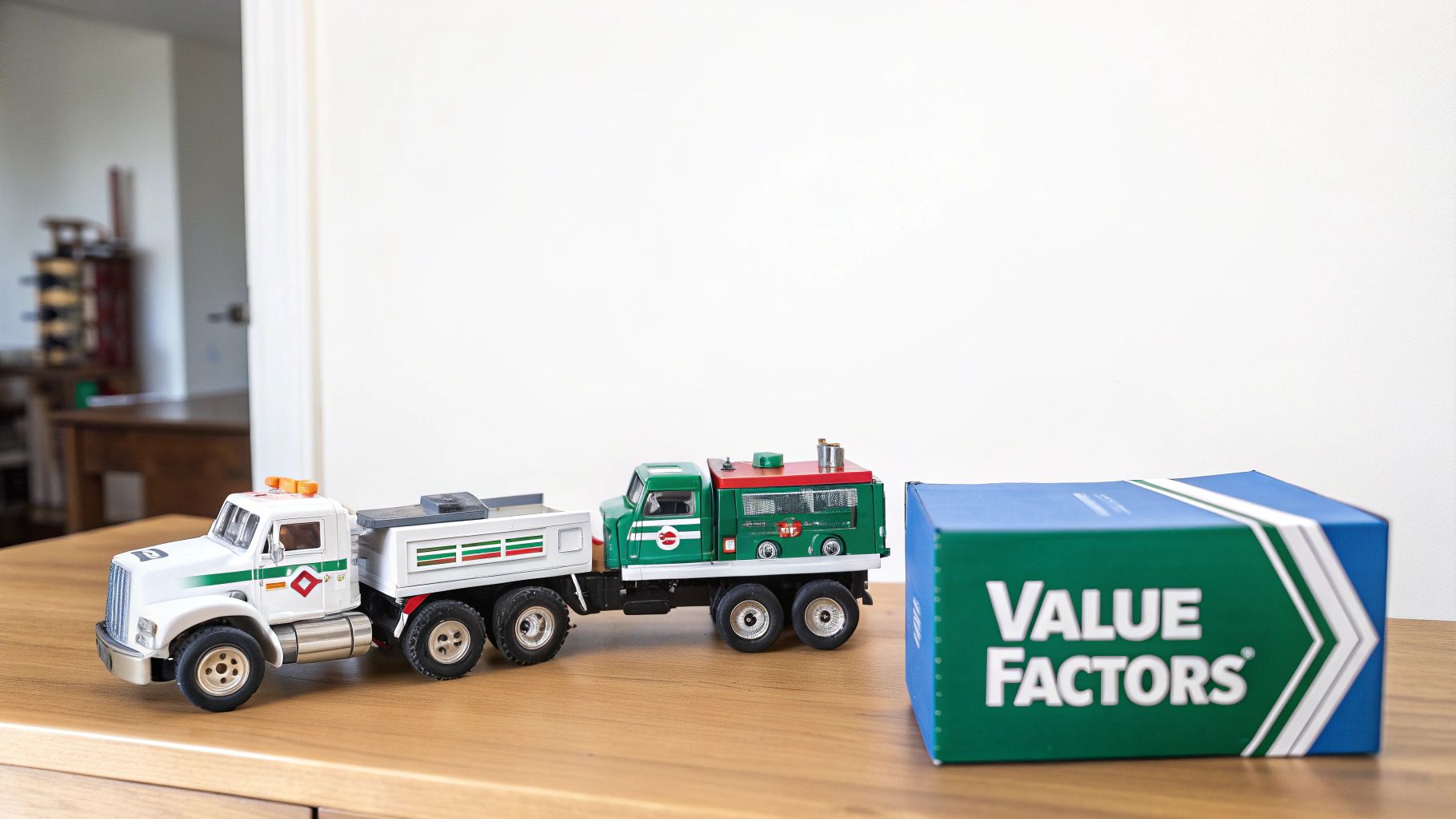
Ever pull an old Hess truck from the attic and wonder if you're holding a little piece of gold? The answer isn't just about age; it’s about the story the truck tells through its history and preservation. Think of it like a classic car—a shiny paint job doesn't mean much if the original engine is gone. The same logic applies to these iconic green and white collectibles.
The story starts with the very first Hess Toy Truck, a tanker trailer modeled after Hess's own B61 Mack truck. When it hit the gas stations on Thanksgiving Day in 1964, it cost just $1.39, batteries included. Fast forward to today, and that same 1964 original can fetch nearly $2,500 on the collector's market. That's the power of rarity and nostalgia. You can learn more about the early days of these iconic toys and their journey to becoming collectibles.
The Four Pillars of Hess Truck Value
To really size up any Hess truck, you have to look at four key areas. They all work together, and a weakness in one can pull down the value of the others.
- Year and Rarity: The older trucks, especially from the 1960s and '70s, were made in much smaller numbers. Simple supply and demand makes them harder to find and more valuable.
- Condition: This is a big one. You're looking for flawless paint, shiny chrome, and electronics that still work. Any scuffs, yellowed plastic, or damage will drop the price.
- Completeness (Truck): Are all the little pieces there? Every tiny helicopter, motorcycle, or rescue vehicle needs to be present and accounted for.
- Completeness (Packaging): The original box, the cardboard inserts, and even the little battery instruction card are critical. A truck without its box is worth just a fraction of one that's "Mint In Box."
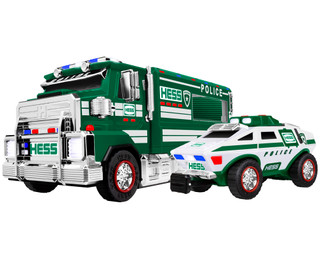
For example, the recent 2023 Hess Police Truck and Cruiser is a great modern collectible, but it's still widely available. Compare that to a classic like the 1964 Hess Tanker Trailer, and you see the difference. The '64 model is the holy grail for many collectors because its age, rarity, and history give it immense value.
A common mistake new collectors make is underestimating the box. The original packaging can easily account for up to 50% of a Hess truck's total value. It's like a time capsule that proves its authenticity and how well it was cared for.
At the end of the day, a complete, pristine vintage model will always be worth more than a modern one, no matter how cool it is. This guide will walk you through each of these pillars, giving you the tools you need to evaluate your collection like a seasoned pro.
How to Grade Your Hess Truck Like a Pro
In the world of Hess collecting, condition isn’t just important—it's everything. A flawless truck can easily be worth hundreds, or even thousands, more than one with a few minor scuffs. Think of it like a detailed inspection for a classic car; every single element, from the chrome on the grill to the cardboard inserts in the box, plays a part in its final value.
This part of the hess truck value guide will teach you to see a truck through a professional's eyes.
The holy grail for collectors is a truck that is Mint In Box (MIB). This means the truck has never been out of its packaging, except maybe for a quick peek. The box is still crisp, the colors pop, and all the original inserts—including the battery card—are present and untouched. It's a perfect time capsule.
As you move down the grading scale, you'll hear terms like "Near Mint," "Excellent," and "Good." The differences might seem small, but they make a huge difference in the price. A Near Mint truck might just have a tiny scuff on a box corner, while an Excellent one could have slightly faded decals or a minor scratch on the truck itself.
Hess Truck Grading Condition Matrix
To make sense of it all, collectors use a fairly standard grading system. This table breaks down what each grade really means for both the truck and its packaging, and how that impacts what someone is willing to pay.
| Grade | Truck Condition Description | Box & Inserts Condition | Value Impact |
|---|---|---|---|
| Mint (MIB) | Absolutely flawless. No scratches, scuffs, or discoloration. Never played with. | Perfect. Sharp corners, vibrant colors, no tears or creases. All original inserts are present and pristine. | 100% of market value. This is the benchmark. |
| Near Mint | Almost perfect. May have a minuscule, barely visible factory flaw or tiny mark. | Box is sharp with very minor shelf wear, like a slightly soft corner. All inserts included. | 85-95% of market value. Very desirable. |
| Excellent | Lightly handled or displayed. May have a few minor scratches, light decal wear, or faint discoloration. | Box is solid but shows clear signs of handling. Minor creasing, corner wear, or a small tear. Inserts are present but may be creased. | 60-80% of market value. A solid collector's piece. |
| Good | Clearly played with. Obvious scratches, scuffs, and decal peeling. Might be missing a small, non-critical part. | Box is complete but has significant wear: crushing, tears, stains, or writing. Inserts may be missing or damaged. | 30-50% of market value. Often a "display" or restoration piece. |
| Fair/Poor | Heavily played with. Significant damage like broken parts, deep scratches, or heavy discoloration. May be missing major parts. | Box is heavily damaged, torn, or incomplete. Often missing most or all inserts. | 10-25% of market value. Primarily valuable for parts. |
Understanding these grades is the first step to knowing exactly what you've got—and what it's truly worth.
The Essential Inspection Checklist
To grade a Hess truck right, you need to be systematic. Don’t just give it a quick glance; get a good light source and check every detail. This checklist covers the key spots that separate a top-tier collectible from an old toy.
- Chrome and Brightwork: Check all the chrome parts for any peeling, pitting, or scratches. On the older models, this is often the first place to show wear. Bright, reflective chrome is a great sign.
- Decals and Logos: Are the decals crisp and perfectly aligned? Look closely for any peeling, fading, or yellowing, which often happens with age and sunlight exposure.
- Plastic Body: Inspect the truck's body for scratches, scuffs, or discoloration. The white plastic on many models is famous for turning yellow over time if it wasn't stored properly.
- Small Parts and Accessories: Account for every single detachable part—ladders, hoses, helicopters, motorcycles, you name it. A missing side mirror or a tiny antenna can seriously knock down a truck's grade.
- Lights and Sound: If you can, test the electronics. Corroded battery terminals are a huge red flag, since battery acid can cause permanent damage. A clean battery compartment is a must.
Take the 2006 Hess NYSE Truck and its collectors certificate, for instance. It's a limited-edition model that fetches high prices. A collector inspecting this piece would meticulously check its unique stock ticker feature and make sure the collector's certificate is in perfect shape. You can learn about this executive rarity on the Hess Truck Collectors website to see what makes it so special.
Understanding the Box and Inserts
Never underestimate the box. An original box in great shape can easily account for 40-50% of the truck’s total value. When you're looking at the packaging, you want to see sharp corners, bright graphics, and no crushing.
A common mistake is overlooking the internal cardboard inserts. These custom-fitted pieces don't just protect the truck; they prove it's the real deal. A truck with a perfect box but missing inserts will never be considered Mint.
There are usually two main inserts—a top and a bottom piece—that hold the truck in place. They should be clean, with no tears, and fit snugly. Any water stains, writing, or crushing brings the grade down. The original battery card is the final piece of the puzzle, and having it is a hallmark of a complete, top-condition collectible.
By carefully checking both the truck and all its packaging, you can confidently figure out its grade and, ultimately, its true value.
The Most Sought-After Years and Models
While every Hess truck has a story, some chapters are worth a whole lot more than others. A few special years and models have become legendary among collectors—the "holy grails" that can define an entire collection. It's not random. It's usually a perfect storm of historical importance, cool design, and just how many (or how few) were made.
These are the trucks that marked a milestone. They represent the very beginning, like the first truck that kicked off the whole tradition, or models that were shaped by big events like the oil embargo. Knowing what makes these specific trucks so special is the key to understanding the real value drivers in the Hess world.
The Icons of the Early Years
The 1960s really set the stage for Hess collecting. The trucks from this decade are prized not just because they're old, but because they represent the birth of a beloved American holiday tradition.
- The 1964 Hess Tanker Trailer: This is the one. The truck that started it all. Its historical importance is impossible to overstate. For many collectors, finding a perfect, complete 1964 model—with its original box and all the paper inserts—is the ultimate prize.
- The 1966 Hess Voyager Tanker Ship: Hess broke the "truck" mold early with this one. The Voyager was a bold, beautifully detailed replica of a real Hess ship. Its unique design and early release date make it a high-value piece and a favorite year after year.
These early models set a benchmark for quality and detail that defined the brand for decades. You can see where the legend began by checking out the 1964 Hess Tanker Trailer, the iconic first Hess toy truck.
Rarity Forged by History
Sometimes, real-world events or quirky production issues create accidental rarities. These moments can turn a standard holiday release into a collector’s dream. The early 1970s gave us a perfect example with a fire truck that’s now famous for its variations.
The 1970/1971 Hess Fire Truck is a masterclass in how circumstance creates value. This model is known for a few rare versions, including some stamped with "Made in USA" and a 1971 release sold in a plain white box because of supply chain problems. Those small differences can make a huge difference in price.
This era also brought new features. The 1985 Hess Truck Bank was the first to include a coin slot, a popular feature that ended with the 1989 White Fire Truck Bank.
It’s amazing to see how the craftsmanship evolved. The first 1964 truck was made of just 75 plastic parts. Newer trucks have between 200-300 individual components. That jump in complexity goes hand-in-hand with the soaring collector values.
This decision tree gives you a visual for how a collector thinks when grading a truck and figuring out what it's worth.
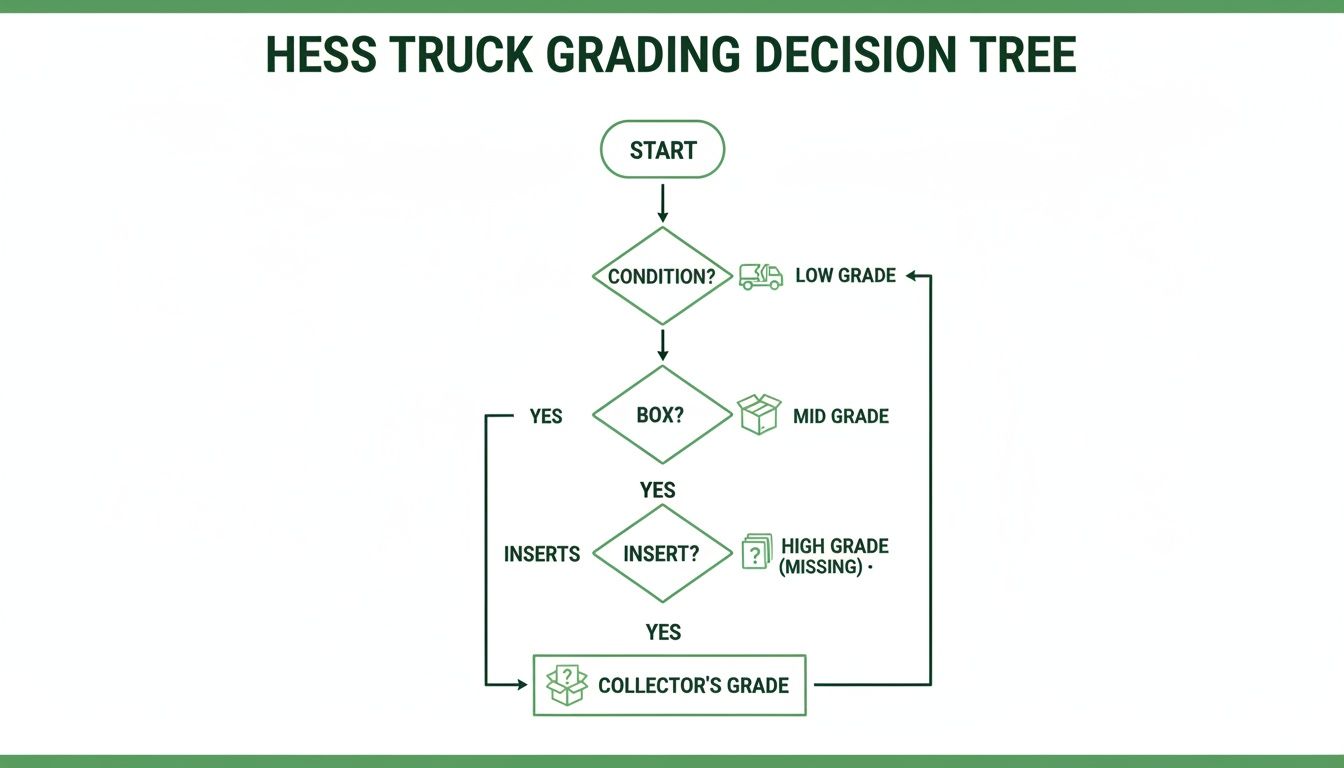
As the chart shows, getting to that top-tier value means checking all the boxes. The truck, the box, and every single insert have to be in fantastic shape.
Modern Classics and Future Grails
While the vintage trucks get a lot of the attention, don't sleep on some of the key releases from recent decades. Certain models are already considered "modern classics" because of their unique designs, limited numbers, or special meaning.
Take the 2006 Hess Truck and Helicopter, for instance. It was a huge hit with fans, thanks to its big, detailed helicopter and awesome light and sound features. Another one to watch is the 2015 Hess Fire Truck and Ladder Rescue, which celebrated the 50th anniversary of the first fire truck with a ton of cool functions.
They might not be as rare as the 1960s trucks just yet, but these models in mint-in-box condition are steadily climbing in value. They’re definitely essential pieces for any serious, complete collection.
Decoding Scarcity and Special Editions
Ever wonder why one Hess truck fetches hundreds more than another from the same year? The answer isn't just about age; it's about scarcity. Digging into the subtle differences that make a truck a true rarity is what separates casual collectors from the experts and is a critical part of any Hess truck value guide.
It’s all about telling a standard issue apart from a special release. Think of it like collecting coins: a 1943 penny is cool, but a 1943 copper penny is a legend because of a production mistake. Hess trucks have their own versions of these stories, where tiny details create massive value.
Rare Variations and Packaging Anomalies
Sometimes, the box is worth more than the truck inside. Production hiccups, unexpected supply chain problems, or even regional test markets have created some of the most sought-after Hess variations. These aren't intentional special editions, but happy accidents that sent a handful of unique items out into the world.
The most famous example is the 1971 Hess Fire Truck that was sold in a plain white box. A packaging shortage meant a limited run of these trucks shipped without the usual colorful artwork. Finding one of these "white box" editions in good shape is a major score for any collector, making it far rarer than the standard version from that year.
Limited Series and Promotional Exclusives
Beyond production quirks, Hess has also created scarcity on purpose with special, limited-run series. These are often made to celebrate company milestones or create unique collectibles outside the main holiday lineup. They’re produced in much smaller numbers right from the start, guaranteeing their value.
- The Hess Mini Collection: Introduced in 1998, the Hess Miniature Trucks are small-scale replicas of classic holiday trucks. Released in limited quantities, they give collectors an easier way to own a piece of Hess history and have become a wildly popular series all their own.
- Promotional and Corporate Editions: These are the true "insider" trucks. On rare occasions, Hess has made trucks just for employees or corporate events that were never sold to the public. You can usually spot them by their special packaging or a small change to the truck itself.
One of the best-known promotional exclusives is the 2006 Hess NYSE Truck. This model was created to celebrate Hess Corporation’s listing on the New York Stock Exchange and was only given to executives and special guests. You couldn't buy it at a gas station.
Because these trucks had such a private and limited distribution, they are incredibly hard to come by. This built-in scarcity makes them a top-tier prize. You can learn more about the unique backstory of the 2006 Hess NYSE Truck and its collectors certificate, a true executive rarity, to understand why these models are such a smart investment.
The Value of Backstory
Every rare truck has a story that explains why it's so scarce, and that story is a huge part of its appeal. A low production number is one thing, but knowing a truck was made for a specific, one-time event or came from a quirky moment in history adds a layer of cool that goes beyond just supply and demand.
For collectors, owning a special edition is like owning a tangible piece of Hess corporate history. It’s an artifact from a specific moment, whether that was a packaging shortage in the '70s or a major corporate milestone in the 2000s. Spotting these rare gems takes a sharp eye and real knowledge, but the reward is adding a true centerpiece to your collection.
Verifying Authenticity and Spotting Fakes
In a market where a single truck can be a serious investment, knowing how to tell a genuine classic from a clever fake is an absolutely essential skill. Think of this part of the hess truck value guide as your personal authentication toolkit, designed to help you buy and sell with total confidence. The secret is looking past the obvious and zeroing in on the tiny details that counterfeiters almost always get wrong.
Your first line of defense is the truck itself. Real Hess trucks have specific tells that are tough to replicate perfectly. Start by flipping it over and checking the undercarriage for tooling marks and the "Hess" logo. The font, its placement, and even the depth of the branding need to match what you see on known authentic examples.
Reproduction parts are another huge issue. Be skeptical of chrome that looks a little too perfect on an older model, or decals that seem brighter and feel thicker than the originals. A little homework goes a long way here. You can jump over to the official Hess Truck Collectors photo archives to see exactly what an authentic 1964 Hess Tanker Trailer is supposed to look like. It's an invaluable reference.
Your Authentication Checklist
When you come across a deal that seems too good to be true, it probably is. It's time to slow down and get methodical. Use this checklist to give any potential purchase a thorough once-over, especially when you're looking at high-value vintage models.
- Box Construction and Color: Authentic Hess boxes from the 1960s and 70s have a very distinct feel and color. Fakes often use modern, overly glossy cardboard, or the colors are just slightly off. Look for crisp, precise printing with no blurriness in the logos or text.
- Inserts and Paperwork: Fake inserts are often made from flimsy, bright white cardboard. Original inserts are typically a sturdier, off-white material that cradles the truck perfectly. The battery instruction card should also have the correct font and paper texture for its time.
- Truck Details: Get up close and check the seams, molding lines, and the overall quality of the plastic. Hess always maintained high manufacturing standards, so sloppy assembly or cheap-feeling plastic are major red flags.
- Electronic Functionality: While not a foolproof sign of authenticity, always check that the lights and sounds (if it has them) work correctly. Fake models might use cheaper electronic guts that don't match the original functions.
In the high-end collector market, "provenance" is everything. This is simply the documented history of a truck's ownership. A truck with a clear, verifiable history from a known collection often fetches a premium because its authenticity is already well-established.
The Tell-Tale Signs of a Doctored Box
A common trick is to "marry" a truck in great shape with a box that was sourced separately to create a "complete" set. Even more deceptive are doctored boxes, where sneaky repairs have been made to hide tears and flaws.
Look for faint signs of glue residue around torn flaps—a dead giveaway of a repair. Check for mismatched color fading; a box that's faded on one side but looks brand new on another was likely pieced together from multiple damaged boxes. For the really serious collector, running a blacklight over the packaging can reveal modern adhesives or paper repairs that are completely invisible to the naked eye.
Ultimately, your best defense is knowledge. The more you learn the subtle quirks of genuine Hess trucks and their packaging, the easier it will be to spot fakes and protect your collection from costly mistakes. Trust your gut, and whenever possible, stick to buying from reputable sources.
Preserving the Value of Your Collection
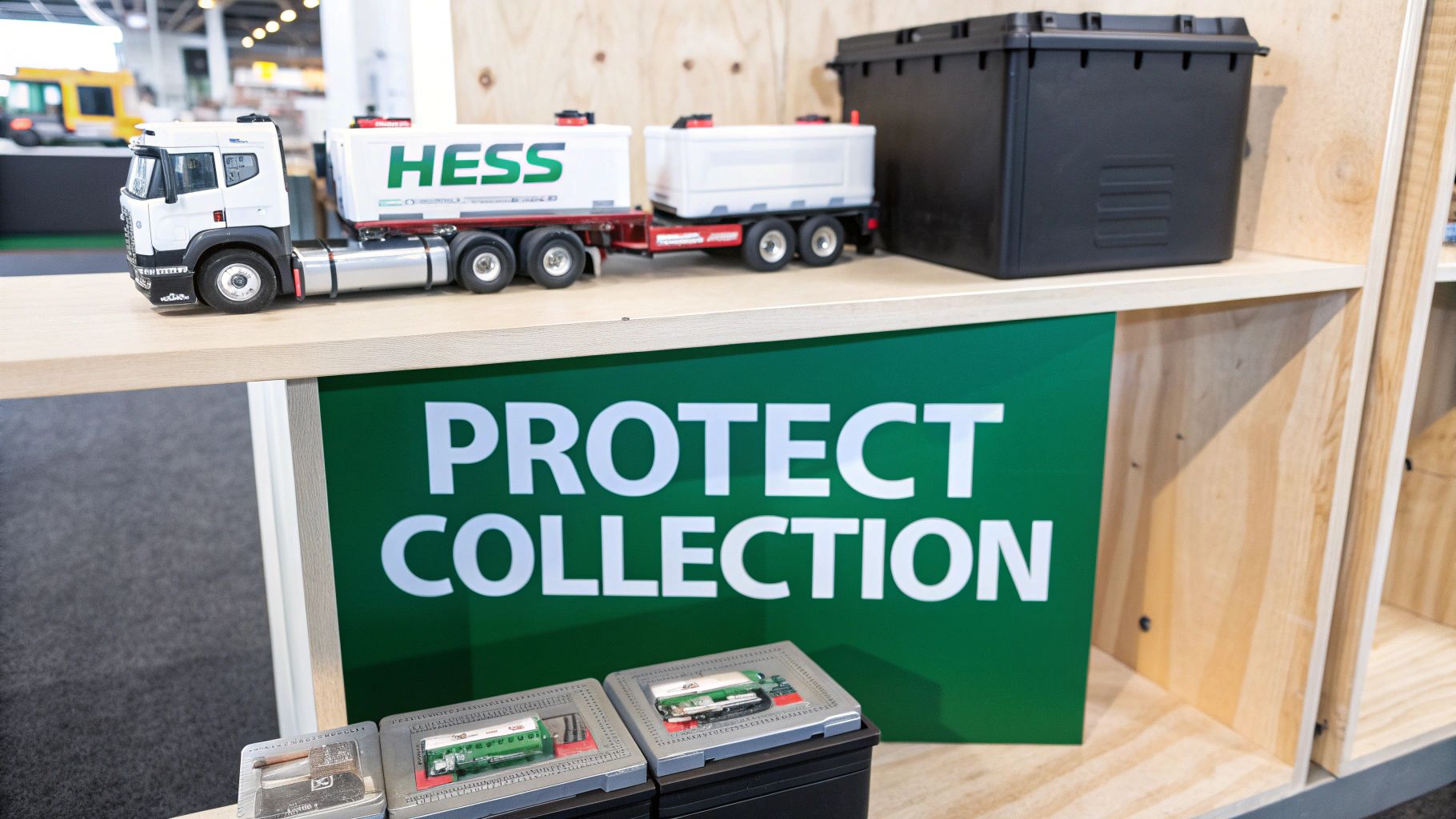
Getting your hands on a classic Hess truck is just the start. The real work begins with safeguarding its condition to secure its long-term worth. Your collection is an investment of both passion and money, so protecting it from common enemies like sunlight, humidity, and battery corrosion is absolutely crucial.
Think of preservation as an ongoing part of the hobby. Proper storage isn't just about showing off your trucks—it's what prevents the kind of damage that can erase hundreds of dollars from a truck's price tag. This part of our hess truck value guide will give you practical advice to protect your treasures.
Proper Storage and Display Techniques
The best place for your collection is a climate-controlled space with stable temperatures and low humidity. Attics and basements are usually the worst choices. Their extreme temperature swings and moisture can warp boxes, peel decals, and ruin your investment.
Sunlight is another silent destroyer. It's notorious for yellowing the iconic white plastic and fading the vibrant colors on the boxes. If you put your trucks on display, make sure they are nowhere near a window.
- UV-Protective Cases: For your most valuable models, it’s worth investing in acrylic cases that filter out harmful ultraviolet rays.
- Archival Boxes: Always store boxes flat to prevent warping. If you need extra protection, use acid-free materials.
- Stable Environment: Your best bet is a room where the temperature stays consistent all year, like a closet in the main part of your house.
To help you protect your investment, Hess Truck Collectors offers a variety of storage solutions. The Clear Vinyl Protective Box 'Sleeve' for Hess Trucks is a perfect way to shield the original packaging from scuffs and dust without hiding that classic artwork.
The Most Important Preservation Step
There is one golden rule every serious collector follows, no exceptions: always remove the batteries before storage. Leaving batteries inside a truck is a ticking time bomb.
Over time, batteries will leak potassium hydroxide, a corrosive substance that can destroy the delicate electronic components, stain the plastic, and permanently ruin the truck’s lights and sounds. A clean battery compartment is a hallmark of a well-maintained collectible.
This simple, two-minute task can prevent irreversible damage that will tank a truck's value. Make it a non-negotiable habit. The moment a new truck joins your collection, take the batteries out. This single action is the most effective thing you can do to ensure your Hess trucks stay pristine and functional for future generations to enjoy.
Common Questions From Collectors
Whether you're new to the hobby or have been collecting for decades, a few questions always seem to pop up. Here are some straightforward answers to help you build and manage your collection with confidence.
Should I Take My Hess Truck Out of the Box?
For maximum value, the simple answer is no. A Hess truck’s peak worth is achieved when it remains Mint In Box (MIB), with the original factory seals unbroken. The moment you open it, it's no longer "untouched."
Even if you're incredibly careful, just handling the truck can introduce tiny flaws an expert grader will spot. The original packaging—the box itself, all the cardboard inserts, and even the little battery card—is a massive part of the truck's overall grade. For serious collectors, that complete, sealed package is like a perfect time capsule.
Are Hess Mini Trucks Worth Collecting?
Absolutely. They might not fetch the same sky-high prices as some of the full-size vintage models, but Hess Mini trucks are a hugely popular and respected part of the hobby. Since they first appeared in 1998, these smaller replicas of classic trucks have always been produced in limited quantities.
They're a fantastic and more accessible entry point for new collectors, letting you own a piece of Hess history without the price tag of a 1960s original. Plus, their value tends to appreciate steadily, making them a smart and fun addition to any display. The 2023 Hess Mini Collection, for instance, is a popular set that includes tiny versions of past full-sized trucks.
A key takeaway for new collectors is that "value" isn't always just about the price. The Mini series is beloved for its detailed craftsmanship and the nostalgia it offers in a compact, display-friendly format.
How Do I Know if My 1980s Hess Truck Is Valuable?
The value of any truck from the 1980s hinges almost entirely on its condition and completeness. Models from this decade, like the 1985 First Hess Truck Bank or the 1982 First Hess Truck, are incredibly desirable if they're in pristine shape.
This means you need a crisp, clean box with every single original insert. A big thing to look for is any yellowing on the truck's white plastic parts—a common issue that lowers the value. The 1980s was a period of innovation for Hess, so finding a flawless example of these models is a big deal. For instance, a complete 1980 Hess Training Van is a sought-after piece that perfectly captures the era.
At Hess Truck Collectors, we provide a trusted source for both iconic classics and modern favorites. Whether you're searching for a vintage treasure or the latest release, you can explore our extensive collection to find the perfect addition to your display. Discover authentic and hard-to-find Hess Trucks at hesstruckcollectors.com.
Produced via the Outrank tool